


John Peterson
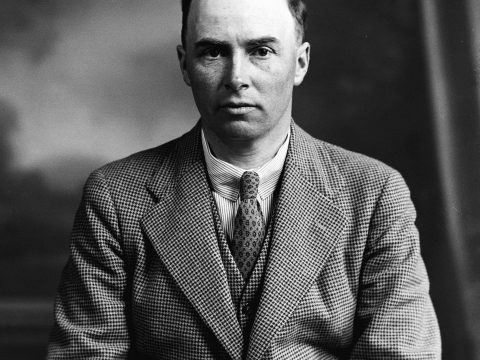
John Peterson, known as Jack, was the oldest child of seven of John Scott Peterson, schoolteacher at Gruting on the Westside of Shetland and his wife Christina Ann (nee MacInnes), his fellow-teacher in the Gruting school.
Jack lived the rigorous life of a child in a country schoolmaster’s household at the end of the Victorian era. His enjoyment of that way of life is evidenced by his later affection for the traditional ways of Shetland, as his unpublished novel Hakkie clearly shows. Like all his brothers he became a skilful handler of boats; the Peterson brothers were among the leading contenders at all the Westside regattas before the First World War, and again afterwards.
During the First World War Peterson served in the Seaforth Highlanders. He was wounded during action at the Battle of the Somme, and a second time suffered a severed femoral artery, owing his life to the timely application of a tourniquet in the form of a rifle sling. He never knew who had stopped to perform this service for him, or whether he had in fact done it himself.
The conflict affected Peterson so adversely that he advised his younger brother James MacInnes (‘Mac’) to volunteer for another service rather than wait to be conscripted into the infantry; Mac joined the Royal Naval Air Service and survived the war.
After the war Peterson returned to Shetland to recuperate. There his father supported his growing interest in photography. John Peterson senior had first ordered a camera for his own use in 1893, and Jack very soon became adept at photography, and had a dark-room for processing plates and photographs set up at home.
When he had returned to full health, Peterson succeeded in qualifying to enter the Customs and Excise Service. He served as customs officer in a number of places in Scotland, including Orkney, and it was possibly while serving there that he met Belle Skea of Deerness, whom he married. When the opportunity was offered, Peterson took up the post of Principal Customs Officer in Lerwick, and it was there that he spent the rest of his life, continuing after his retirement to live in the house he had built for Belle and himself in Twageos Road in Lerwick. The couple had no children, and after Jack’s death in 1972 Belle returned to Orkney.
Peterson’s passions for photography and for Shetland continued through his life. He brought out Shetland: a photographer’s notebook in 1948, and the Shetland Library and Museum published his Shetland: notebook number two posthumously in 1985. Probably his most well-known photograph is that of an arctic tern in flight viewed from below, which won many prizes and is now something of a Shetland icon. He bequeathed his photographs to the Shetland Library and Museum and the whole collection is now accessible through their web-site.
He served for a long time on the editorial board of the New Shetlander magazine, in which he collaborated with the Graham brothers in investigating and promoting all aspects of Shetland folk traditions. He was also interested in Shetland wildlife, and was a skilful ornithologist, as well as a keen fisherman, and never happier than when in a boat.
Peterson was deeply committed to the politics of the left. It is possible that the experience of the war led him to become a convinced supporter of Socialism as the only possible realistic political future for mankind; he never wavered from that view despite later political developments.
The baleful influence of the First World War never left Jack Peterson, though he rarely talked about it. It was a nightmarish interlude in his life, as in the lives of so many at that time, and is vividly painted in the pages of the novel Hakkie as well as in his war poems. Hakkie, whose eponymous character endured the violence of the front line, has remained unpublished, and is held by the Shetland Archives, though excerpts have been published in the New Shetlander.
Peterson’s war poems are to be found in his two 1920s books of poetry, Roads and Ditches and Streets and Starlight. They are angry poems that wish to spare the reader nothing of the horrors experienced by the fighting men:
So I will cease my singing,
And take you by the hand,
Down days and darksome ditches
To the night of No-man’s-land.
Where the day is full of horror
That words may never tell,
And the twilight full of terror,
And life is laughing hell.
from ‘War’
‘The Waste’ has a nightmarish quality of a battlefield deserted, as if the poet surveys the scene from above:
A thousand sentries have ‘stood down,’
Have left their fire-steps lonely to the stars.
No longer endless, snakey transport winds
Its limbered length for crawling miles;
A million ceaseless men who came and went
All day, all night, have gone, nor come again;
And all is silent in the silent waste.
Peterson was adept too at describing the smaller details of the soldiers’ lives; the poem ‘Billets’ describes the welcome respite of a night out of the front line, when the thankful soldiers collapse with exhaustion:
‘So, reeking damp, still, motionless, they lie
As dead, a few who fought and did not die.’
Peterson returned to the theme of the conflict in some of his later poetry: ‘Great Wars’, for example, was published in the New Shetlander in 1965. In this the poet recounts his memory of a fellow islander at the front greeting him with a ‘smile that put the world to shame’; his acquaintance’s old-worldly courtesy so alien in that place of horror.
Streets and Starlight (1923) has a small section of poems in rich Shetlandic, from the neat eight-lines of ‘Da Corbie’ to ‘Shetlan’, written with love for his homeland and which must tug the hearts of all who belong there. The acclaimed ‘Seine Netters’, a much later piece, is a remarkable picture of the boats, the netting and the working lives of the local fishermen in the 1960s:
Venture calling Daybreak –
Daybreak – Daybreak – Daybreak –
What’s da price a haddocks
In Aberdeen da day? …Da price! Da price! An da Nort Baas brakkin!
What’s da price, braks a winter’s gale?
Senses tuned ta a wirld obstropolus
Ready ta act sood onything fail.What’s da price, an da squall comes dirrlin:
Black aa roond, nor ever a glaem –
Compass, wheel, an a ee ta windward,
Haddin da rodd da Norsemen cam haem.
Dr Mark Ryan Smith has written of Peterson as being the first Shetland poet to step out of 19th century patterns of writing; certainly the experience of the First World War stirred him, as many other poets, to find new ways of expression. Peterson carried fresh style forward into his poems in Shetlandic, doing great justice to his native tongue.
2015
With thanks to Mr Magnus Peterson