


Stuart MacGregor
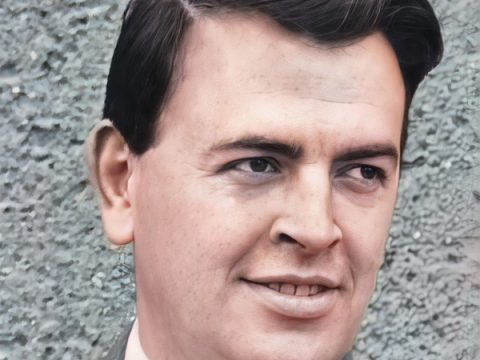
Doctor, novelist, poet, playwright, folk singer and song writer, Stuart MacGregor was hailed in 1970 as one of the finest of Scotland’s coming poets in the seminal anthology Four Points of a Saltire. But the death three years later of this skilled and passionate poet has resulted in literary neglect, although his songs are still being sung.
Stuart William MacGregor was born in Edinburgh on 1st September 1935, the son of Thomas MacGregor, a shopkeeper from Comrie, and Janet Redpath, from the Borders. He was educated at George Heriot’s School before entering Edinburgh University Medical School. As a student he had holiday employment at Cultybraggan Camp, Comrie, and laboured on the local hydroelectric schemes during their period of great development in the 1950s.
After graduating in 1959 he held house jobs at the City and Longmore hospitals. Called up for National Service in 1959, he served in Europe, mainly in the British Army of the Rhine as medical officer attached to the 4th Guards Brigade. Returning to Edinburgh in 1963, he was appointed lecturer in Social Medicine, specialising in the epidemiology of alcoholism at Edinburgh University’s Usher Institute, and was briefly seconded to the Scottish Home and Health Department. In 1972 he gained a year’s appointment as visiting lecturer in Social and Preventative Medicine at the University of the West Indies but died in a car crash in Jamaica on 25th January 1973, when returning from visiting a fellow Scot. A Stuart MacGregor Memorial Prize was established by Edinburgh’s Department of Community Health.
In October 1960 he had married Jane MacDonald, a school teacher from Tigharry, North Uist. She had been introduced to Stuart by a nurse at the Royal Infirmary; by this time Stuart had learned both German and Gaelic. They had three children, two sons and a daughter, between 1961 and 1966.
After his death, Jane served as a research assistant on the Tiree Project at the School of Scottish Studies until 1986.
During his time as a houseman at the City Hospital MacGregor published The Myrtle and Ivy , first drafted in Düsseldorf in 1961-2. The title refers to:
Oh, talk not to me of a name great in story;
The days of our youth are the days of our glory;
And the myrtle and ivy of sweet two-and-twenty
Are worth all your laurels, though ever so plenty.(Byron: ‘Stanzas Written on the Road between Florence and Pisa’)
The hero is a 22 year-old final year medical student, in 1958, prone to violent solutions of his problems with life, love, Scottish identity and career.
The Sinner (1973) had been accepted for publication before Stuart’s death, but was published posthumously. It portrays aspects of Edinburgh life in the 1960s – the medical world, the literary arenas, the life of the pubs and slums, the folk song revival with its constant struggle against commercialism, and the People’s Festival. In some of the characters one may recognise famous names of the period – Hamish Henderson in Nicol Gunn and Jeannie Robertson in Maisy Hay – although MacGregor refused to confirm this.
There are four unpublished novels, as well as short stories in his papers, which are held in the National Library of Scotland.
MacGregor’s play The Month of Mary Paterson was a BBC Scotland broadcast in the late 1960s, produced by Stewart Conn to critical acclaim. There are three more radio plays and four unpublished theatre plays in his papers.
Together with Hamish Henderson, Stuart founded the Edinburgh University Folksong Society in 1958, and was elected its first President. In 1970, he compèred and performed at the first meeting of The Heretics, which had been founded in order to provide a forum for young poets, singers and musicians, such as Donald Campbell, Liz Lochhead, Phil and Johnny Cunningham [of Silly Wizard] and writers such as Hugh MacDiarmid, Sorley MacLean and Iain Crichton Smith.
A singer who played guitar and piano, MacGregor composed and sang ‘Coshieville’, ‘The Sandy Bell’s Man’, ‘South Side Blues’ and ‘The Presence’ (music in this case by Archie Fisher) – songs sung to this day.
Having heard MacGregor recite his poetry in performances with The Heretics, in 1970 Gordon Wright published 33 of the poems, introduced by Tom Scott, in the seminal book Four Points of a Saltire. Posthumously, Malcolm (‘Calum’) Macdonald published Poems and Songs in 1974, introduced by John Herdman, his literary executor. It contains fifteen ‘Scottish’ poems, ten ‘Letters from the Sunset’ (Jamaican poems) and five song texts. His unpublished Scottish and Jamaican poems are held in the National Library of Scotland.
(Stuart MacGregor’s family has contributed the following paragraph of personal details):
‘Physically MacGregor was not tall at about 5’ 7″. In his teens he had suffered a bad rugby injury which resulted in a year’s convalescence, but in any case tallness was not a family characteristic. He had the stocky frame of a boxer, and indeed excelled in the sport in upper school, as he also did in golf. He had a raucous laugh, a charismatic presence and tremendous nervous energy. One outlet for this was the wooden walking stick which invariably accompanied him as he prowled all over Edinburgh, and which was wielded as a weapon rather than a support. As he walked his mind was always elsewhere, and frequent outbursts of laughter provoked wonderment in strangers. On the occasions when he accompanied his daughter to and from school, she resorted to walking behind him and mimicking his movements, to convince the general public that a game was in progress. He possessed a great love of Edinburgh and of Scotland, and a huge and genuine compassion towards others, but was equally prone to growing impatient with friends or acquaintances who outstayed their welcome, and of abandoning them in the expectation that his wife would step into the breach. Socially and culturally, he was an uninhibited, galvanising and catalytic force. At times the family home could turn into an extension of Sandy Bell’s Bar: a gathering point for literati, folk musicians, nationalist politicians, activists and sympathisers, Gaelic speakers and singers, academics and students, all of whom mingled with the eccentric, the down and out, the lost and the merely curious. His profound impact upon those who had only just met him was remarkable, and the love and affection which he inspired in so many was reflected in the turnout at his funeral. The public persona, vivid, vital and extrovert, belied a very self-absorbed, insecure and troubled man, who said of himself that ‘the wild, wounded ink was my soul’. ‘
From both his published poems and other works, together with the wealth of material that was being prepared for publication and now held in the National Library, it is clear that Scotland lost a prolific writer of remarkable ability and vitality by Stuart MacGregor’s death at the age of only thirty-seven.
The background to his poetry extends from Edinburgh and Germany, through Perthshire to North Uist (although fluent in Gaelic he never published poetry in that medium), and finally to Jamaica. Love in many forms is mingled with a brave consideration of mortality, and of the meanings of family and ‘Scottish place’. A skilled craftsman, he could handle forms from the villanelle to free verse. His poems were written with an intensity of feeling and passion, especially marked in powerful ballad stanzas, as is seen in ‘The Border Story’:
Then Scottish blades of fiery boast
Beware of myths and martyrs,
The fools of love who weep the most
Don’t always wear the garters.The witch’s guile, the hissing thorn,
Can tear the hearts of all men born,
The dukes, the reapers of the corn,
The beggars and the carters.
Ian Olson
2013