


Roderick Watson Kerr
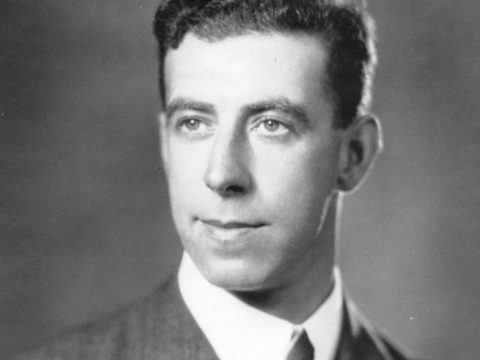
Roderick Watson Kerr was born on January 1st 1895 at Old Monklands in Lanarkshire. His father (also called Roderick) was a master watchmaker. The family moved to Dalkeith shortly after his birth, and then to Edinburgh, living first in Candlemaker Row and then, after the death of Kerr senior, to Salisbury Terrace.
Kerr was educated at Boroughmuir and Heriot’s schools and then attended Broughton Junior Student Centre for several years, where, jointly with John Gould, he edited the Broughton Magazine from 1910-1911. His predecessor in the role of editor had been Hugh MacDiarmid, who, like Kerr, had been under the guidance of George Ogilvie, the teacher who was to prove a catalyst for literary development. While continuing his education during the day, he had joined The Scotsman newspaper as an apprentice, and worked there in the evenings. After Broughton, Kerr enrolled for teacher training at the Edinburgh Professional Training College (which became Moray House) and there too, he edited the college magazine.
Kerr enlisted in the army shortly after the outbreak of war. He was commissioned as a 2nd Lieutenant in the Machine Gun Corps, and from there volunteered to work with the Army’s new weapon, the tank, joining the 2nd Royal Tank Corps after it was founded in 1916. He was awarded the Military Cross for his courage in commanding his tank in action in September 1918, despite being himself badly wounded. After a year in hospital, he was invalided out of the army in October 1919.
After the war, Kerr attended classes at the University of Edinburgh, from 1921 to 1923, leaving to start work as a junior sub-editor at The Scotsman. While at university, Kerr formed a friendship with George Malcolm Thomson; between them, they planned the foundation of a new publishing house to accommodate and promote a new Scottish literary culture. The Porpoise Press started up in 1922. Its first production, launching the first series of contemporary writing in pamphlet form, was a collection of poems by F.V. Branford. The literary quality of the broadsheets was patchy, the editors finding it harder to get first-class writing to publish than they had anticipated. It wasn’t until Kerr’s own issue, No. 10 in 1924, that they came close to the satirical poetry designed to ‘rile the citizenry’ they had originally hoped for. But the stresses of running a small press took their toll, and both men, no longer students, had livings to make. Thomson moved to London in 1925; Kerr took a post as leader-writer on the Liverpool Daily Post & Echo, and left Edinburgh in 1926, but not before acknowledging the ‘spirit of joyous adventure’ which had filled the three years of their work (in a note appended to Thomson’s An Epistle to Roderick Watson Kerr (2nd series, No. 6). The Porpoise Press transferred to the guardianship of Lewis Spence.
Kerr married Joan Macpherson from Kingussie in June 1927; they settled in Liverpool and enjoyed family life until 1939, when Mrs Kerr and the children were evacuated back to her parents’ farm in Kingussie, only returning in 1943 when the danger of bombing in Liverpool was over. Kerr’s job as sub-editor and leader writer with the Daily Post & Echo lasted until his retirement in 1957 – retirement taken early because of illness; he died in 1960.
In an open reference written for Kerr in April 1914, George Ogilvie praised the ‘singular freshness and even originality of expression’ of his writing. Kerr kept a notebook during his active service in the war, with poems drafted in it; they were collected in War Daubs, published by John Lane in 1919. The publisher advertised the book as being the work of one who strips away the false glory of war and makes us look at it in all its nakedness. The Times Literary Supplement commented ‘The trench scenes are powerfully-etched impressions – vivid, intense, sincere’, and a reviewer in the Sunday Evening Telegram said: ‘Mr. Watson Kerr sees with the eyes of the man who has the brains to understand what it all means.’
Hugh MacDiarmid included several of the war poems in the first issue of his anthology Northern Numbers (1920), and hoped for more, but in fact Kerr published very little poetry after the war. His own Porpoise Press pamphlets were satirical pieces; the first, Annus Mirabilis, or the Ascension o Jimmie Broon (1924), Alistair McCleery calls ‘clever humour aimed at obvious Aunt Sallies’. Kerr’s surviving son describes his father sitting daily in the park in the hours before his evening stint at the newspaper in Liverpool, tinkering with another long poem, again of social and political satire, but Kerr’s only other major literary publication was Style of Me: letters of Eula from the U.S.A., in 1945.
Hugh MacDiarmid, in The National Outlook in 1921, wrote that Kerr’s war poetry was ‘the best produced by any Scottish soldier’, and it is for the war poems and his part in the founding of The Porpoise Press that Roderick Watson Kerr will be remembered.