


Place

Once in a while
you may come across a place
where everything
seems as close to perfection
as you will ever need.
And striving to be faultless
the air on its knees
holds the trees apart,
yet nothing is categorically
thus, or that, and before the dusk
mellows and fails
the light is like honey
on the stems of tussock grass,
and the shadows are mauve birthmarks
on the hills.
About this poem
This poem was originally published online as part of a SPL project, supported by Creative New Zealand, which commissioned Scottish writers to introduce a New Zealand poem. The introduction is by the poet, editor, publisher and novelist James Robertson.
I spent two months near the end of 1981 hitchhiking around New Zealand, after a year of work and wandering in Australia. I was 23, travelling alone and light, and I was simultaneously embarked on another journey – to discover the literature of my own country, which my education had declined to inform me existed.
A lot of hours were spent in quiet country places, or on quiet country roads, walking or waiting for lifts. I took the opportunity to memorise 'Tam O'Shanter' and other Burns poems, and I read constantly, among other things a battered old proof copy of Kurt Wittig's The Scottish Tradition in Literature, which I'd found in a second-hand bookshop in Wellington.
I'd been away from Scotland a long time and missed it, but I also found I didn't really know what it was I missed. I kept coming across places – especially in the South Island, Brian Turner country – so beautiful and unspoilt that I had to stop and think hard about why I wanted to go home. Something old-fashioned, rough-edged and unsophisticatedly intelligent about New Zealand touched me back then. I was very self-contained yet very open to the places I journeyed through, and the people I met were also independent yet astonishingly hospitable.
In the light of such good memories, it's interesting to read Brian Turner deplore what he calls the ‘often execrable' modern world. 'I'm one who actually liked New Zealand 30 years ago,' he says. In that same 2005 interview, Turner is asked to explain a comment he once made that 'the reputation you have for cussedness is a front for a lack of confidence.' 'I always felt,' he replies, 'I lacked faith one way or the other…I don't see myself as particularly cussed. It's just that in New Zealand today if you're not perennially smiling… somehow you're said to be letting the side down. The last thing we can have is someone who takes issue with things.' Delight in controversy, pride in thrawnness – now those are traits that chime with the Scottish tradition. Is there such a beast as the Antipodean Antisysygy?
Turner lives in a sparsely populated part of Central Otago called the Maniototo, in a town of 30-40 people. The Maniototo is a high plain bounded by hills – Rough Ridge to the west, the Kakanui range to the north – which experiences extremes of climate, with exceptionally cold winters. He writes a lot about the environment but doesn't want to be 'parked' in the box marked 'landscape poet'. In fact I get a strong sense that he'll climb out of any box anybody tries to put him in. His poems are just as often about relationships, about identity and how that is shaped by where one lives – which gives them a political edge – as they are about the land itself.
Nor is there anything sentimental about the way he writes of mountains, rivers, trees, weather. In one poem he says 'dismiss all talk of "rare beauty" / or "lyric fastness" as piffle. There are / always the hills'. In another, 'Crossing the Canterbury Plains', he seems determined to keep idle speculation out of his description of the view. 'We may travel to the ends of the earth / and back again', he writes, 'and never know whether / the beetle hunched between stalks / feels sorrow'.
So the little poem Place' seems, in the context of Turner's relationship with the environment ('If we look after the world around us properly, other things will follow'), a very precise affirmation of the fact that no view is permanent, that all natural beauty is transient, and yet that it is also constant. If we don't interfere, it will happen again. Or, to reverse the notion (as he does in the poem 'Rees Valley' from Taking Off):
Nothing will happen
today, presumably, evidently,
that hasn't happened before.
If we accept this – accept in other words that near-perfection occurs whether or not we are there to see it – then we might see it more often. The 'air on its knees' holds the trees apart but does not do so for our benefit. Note also that the dusk achieves mellowness even as it 'fails', that the honey-like quality of the light depends on stems of grass, that the 'birthmarks' on the hills are not blemishes and that they do not last.
Turner observes all this and lets it go. He does not try, as with a camera, to capture it. To seek perfection, in fact, is pointless, to see it an illusion. Look then at the careful use and positioning of those adverbs 'presumably, evidently' in 'Rees Valley', and of 'categorically' in 'Place'. I have to pause to unpack the word: categorical, categorise, category. This in turns sends me back to question 'perfection' and 'faultless'. I think Turner is imploring us to use such words with restraint, or precision, or inquiry; to use all language with care and respect. 'I mean, language is beautiful,' he says. 'It can be rigorous. It takes you into territory that you would not have conceived of going to.'
In these and other ways, language and landscape have a great deal in common.
Learn more
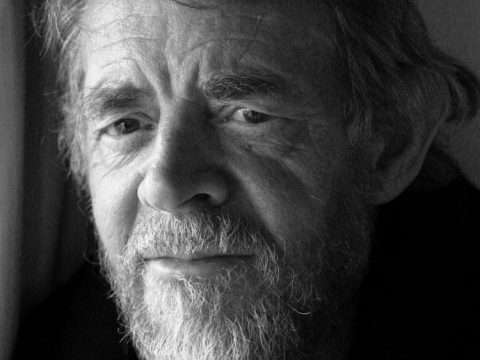

Brian Turner
Brian Turner is a poet, editor, essayist and environmental activist. He was the fourth Te Mata Estate New Zealand Poet Laureate 2003-2005.