


Laird Byron
19 April 2012
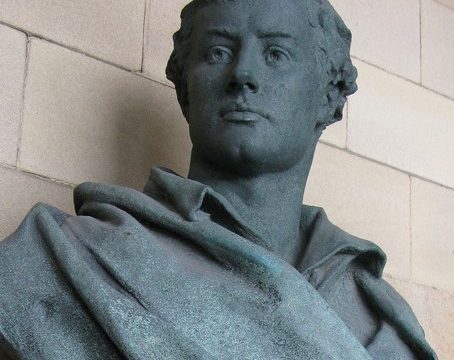
Lord Byron by hummingcrow, under a Creative Commons licence
How Scottish was Byron? Blessed with a baronetcy and educated at Dulwich, Harrow and Cambridge, he might, in other circumstances, be seen as a pillar of the English establishment. He only spent 10 years of his life in Scotland, his first decade more or less, and once he left, he never returned, at least not in person; his imagination is another matter.
Born in London on January 22 1798, Byron’s mother soon took herself and her infant son back to Scotland, to Aberdeen. His maternal grandfather was said to be a descendant of James I of Scotland. At the age of 10, he became the 6th Baron Byron of Rochdale when his uncle died, after which he and his mother returned to England.
His poetry never quite abandoned his ancestral home, though. Early poems like ‘When I roved, a young Highlander’ struck an Ossianic note, while ‘Lachin Y Gair’ praises the Scottish landscape over the English:
England! thy beauties are tame and domestic
To one who has roved o’er the mountains afar:
Oh for the crags that are wild and majestic,
The steep frowning glories of the dark Loch na Garr.
Byron didn’t always feel so benevolently. He never forgave the wounding review an early volume, Hours of Idleness, was given by the Edinburgh Review. Later, he wrote English Bards and Scotch Reviewers which wigged the periodical’s editor Francis Jeffrey, ‘thee chieftain of the critic clan’. His anger was also provoked by what he saw as the outrage of Lord Elgin’s theft of friezes from the Parthenon. In the privately distributed The Curse of Minerva, he wrote a vicious denunciation of Scotland:
Daughter of Jove! in Britain’s injured name,
A true-born Briton may the deed disclaim.
Frown not on England; England owns him not:
Athena, no! thy plunderer was a Scot.
Ask’st thou the difference? From fair Phyle’s towers
Survey Boeotia; – Caledonia’s ours.
And well I know within that bastard land
Hath Wisdom’s goddess never held command;
A barren soil, where Nature’s germs, confined
To stern sterility, can stint the mind;
Whose thistle well betrays the niggard earth,
Emblem of all to whom the Land gives birth;
Each genial influence nurtured to resist;
A land of meanness, sophistry, and mist.
That is not the end of the story. Byron, like many of his peers, became a self-declared fan of Sir Walter Scott when Waverley was published in 1814, initiating a vogue for things Scottish. Perhaps the fashion influenced Byron, who we find being rather more complimentary here:
Who hath not glowed above the page where Fame
Hath fixed high Caledon’s unconquered name;
The mountain-land which spurned the Roman chain,
And baffled back the fiery-crested Dane,
Whose bright claymore and hardihood of hand
No foe could tame – no tyrant could command?
In truth, even without the encomiums, one might detect the Scottish strain in his character. Wasn’t Byron’s fondness for sending up rivals related to the Scots poetic tradition of ‘flyting’? It’s also been said that certain of Byron’s rhymes only really work if pronounced in the Scottish manner; Byron retained a faint Scottish accent throughout his adult life.
As Byron’s fame grew into infamy, and England proved oppressive to his character, the more he came to idealise Scotland as a freer, wilder land whose character informed his own:
I am half a Scot, by birth – and bred
A whole one, and my heart flies to my head,
As ‘Auld Lang Syne’ brings Scotland, one and all –
Scotch plaids, Scotch Snoods, the Blue hills, and Clear Streams,
The Dee, the Don, Balgounie’s brig’s black wall,
All my boy feelings.
When Byron took up arms in Greece’s defence, was he thinking of Scotland? He commented on the similarity of both countries’ landscape. Did he see in Greece’s struggle for freedom a (fanciful) echo of what he imagined was Scotland’s relationship with its larger neighbour? Perhaps we have to accept that, in a sense, his dream of Scotland finally killed him. Byron died on April 19th 1824 from a malarial fever. He hadn’t seen Scotland for a quarter of a century – and never would again.